
"An apostrophe or a comma in the wrong place can spell trouble..."
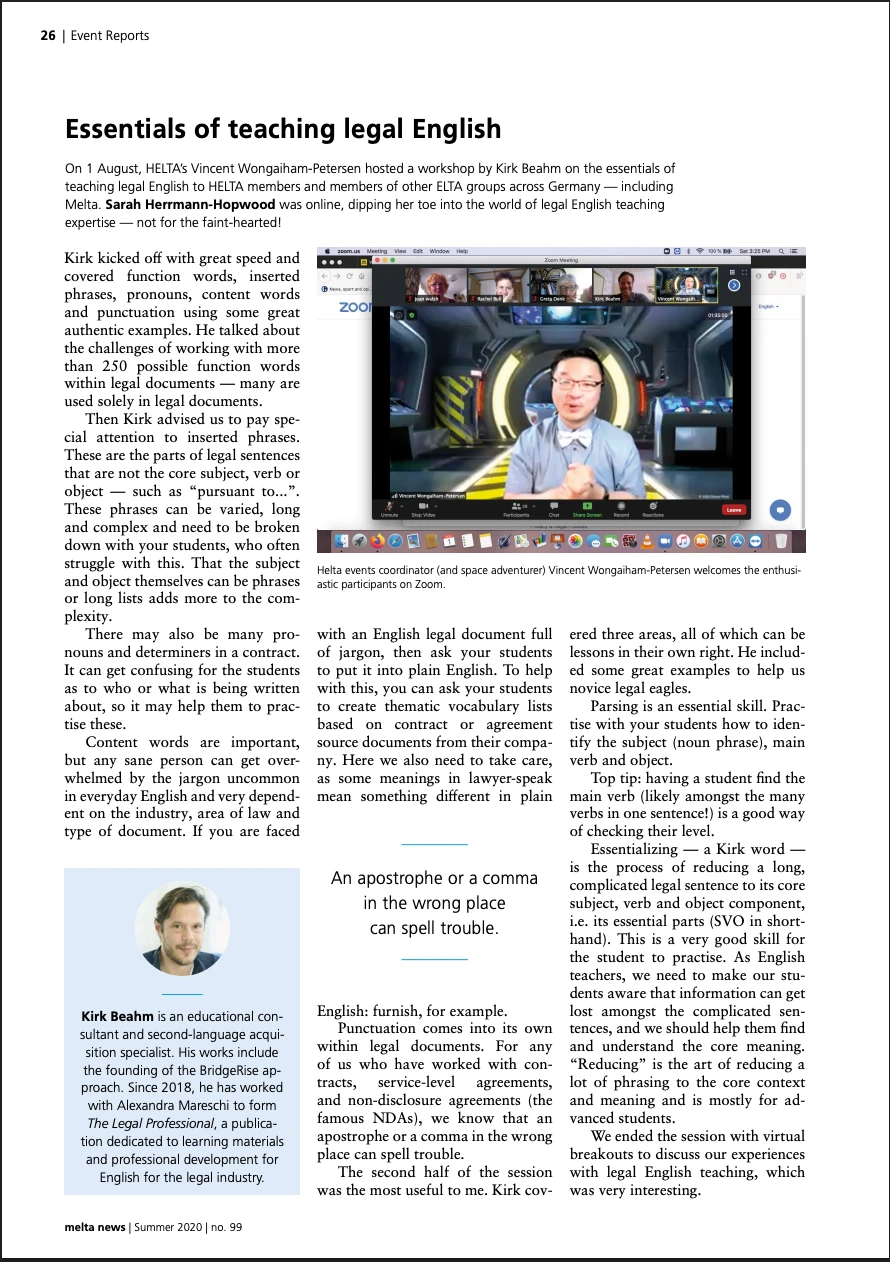
On 1 August, HELTA’s Vincent Wongaiham-Petersen hosted a workshop by Kirk Beahm on the essentials of teaching legal English to HELTA members and members of other ELTA groups across Germany — including Melta. Sarah Herrmann-Hopwood was online, dipping her toe into the world of legal English teaching expertise — not for the faint-hearted!
Kirk kicked off with great speed and covered function words, inserted phrases, pronouns, content words and punctuation using some great authentic examples. He talked about the challenges of working with more than 250 possible function words within legal documents — many are used solely in legal documents.
Then Kirk advised us to pay special attention to inserted phrases. These are the parts of legal sentences that are not the core subject, verb or object — such as “pursuant to...”. These phrases can be varied, long and complex and need to be broken down with your students, who often struggle with this. That the subject and object themselves can be phrases or long lists adds more to the complexity.
There may also be many pronouns and determiners in a contract. It can get confusing for the students as to who or what is being written about, so it may help them to practise these.
Content words are important, but any sane person can get overwhelmed by the jargon uncommon in everyday English and very dependent on the industry, area of law and type of document. If you are faced with an English legal document full of jargon, then ask your students to put it into plain English. To help with this, you can ask your students to create thematic vocabulary lists based on contract or agreement source documents from their company. Here we also need to take care, as some meanings in lawyer-speak mean something different in plain English: furnish, for example.
Punctuation comes into its own within legal documents. For any of us who have worked with contracts, service-level agreements, and non-disclosure agreements (the famous NDAs), we know that an apostrophe or a comma in the wrong place can spell trouble.
The second half of the session was the most useful to me. Kirk covered three areas, all of which can be lessons in their own right. He included some great examples to help us novice legal eagles.
Parsing is an essential skill. Practise with your students how to identify the subject (noun phrase), main verb and object.
Top tip: having a student find the main verb (likely amongst the many verbs in one sentence!) is a good way of checking their level.
Essentializing — a Kirk word — is the process of reducing a long, complicated legal sentence to its core subject, verb and object component, i.e. its essential parts (SVO in shorthand). This is a very good skill for the student to practise. As English teachers, we need to make our students aware that information can get lost amongst the complicated sentences, and we should help them find and understand the core meaning. “Reducing” is the art of reducing a lot of phrasing to the core context and meaning and is mostly for advanced students.
We ended the session with virtual breakouts to discuss our experiences with legal English teaching, which was very interesting.
The plain English movement is good and important in the legal context:
• avoid ambiguity, i.e. the use of too much jargon
• context is everything
• consider the different bodies of law
• cultural awareness is essential
• teaching legal English is not translation
• use authentic material wherever possible.
Like every specialized teaching English topic, preparation is everything. Legal English requires extra time to get to know your subject, but the work will bring rewards, as you share your love of English with students who love working with language and all its complexities.
Sarah Herrmann-Hopwood
Sarah Herrmann-Hopwood was born in the UK. She studied chemistry at Sheffield University and then taught chemistry and science. Sarah then moved to London and started her marketing and advertising career. For 25 years, Sarah worked for advertising agencies around the world. Sarah recently completed the CELTA course at the MVHS and works teaching general and business English in Erding, Munich and online.
Kirk Beahm
Kirk Beahm is an educational consultant and second-language acquisition specialist. His works include the founding of the BridgeRise approach. Since 2018, he has worked with Alexandra Mareschi to form The Legal Professional, a publication dedicated to learning materials and professional development for English for the legal industry.