My CEFR level
The CEFR scale explained
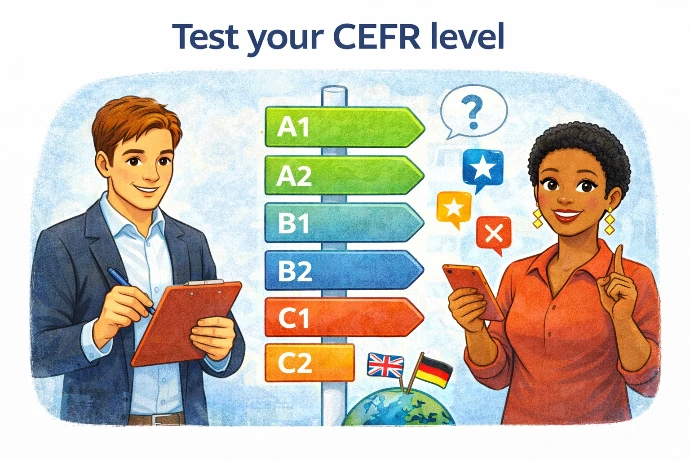
The Common European Framework of Reference for Languages (CEFR) is an international standard for describing language proficiency according to a six-point scale from A1 (beginner) to C2 (proficient).
This effectively divides learners into three groups – Basic Level (A1/A2), Independent Language Ability (B1/B2) and Language Proficiency (C1/C2) – and is a scale used to standardise the assessment of language skills across reading, writing, listening, and speaking.
Most German universities require a language level of B2 for a Bachelor's or Master's degree programme taught in English. Which means many students need to take an assessment test and submit the results to prove that.
In our FAQs further down, you will find out how we can assist you as a student, intern, or employee by passing a language test or getting a certificate from us that you can show a future employer.
CEFR Framework
A very rare status for non-native speakers to achieve, but certainly not impossible. Usually our C2 speakers have spent a lot of time abroad. These speakers can master all challenges and topics in English including academic English.
e.g. Handles complex debate, reads and understands almost as quickly as a native speaker.
The ability to communicate fluently particularly in new subjects or topics that are unfamiliar. Advanced speakers use phrasal verbs, cohesive devices, idiomatic language and apply the conditional and present perfect forms with ease.
e.g. Inspires in English under challenging circumstances such as when pitching or negotiating.
The capacity to achieve most goals and express oneself on a range of topics with a strong grammar foundation despite occasional errors.
e.g. Manages business small talk with ease, engages in a variety of topics without struggling for vocabulary.
The capacity to achieve most goals and express oneself on a range of topics. May typically struggle to use the present perfect form and may have “blocks” on certain more complex subject matters.
e.g. Shows visitors around, engages confidently in routine conversations.
The ability to express oneself in a limited way in familiar situations. Will struggle to manage new situations where vocabulary is unknown.
e.g. Deals with most standard situations on holiday and can write a basic email or letter.
An ability to deal with simple, easy-going information and begin to express oneself in more familiar contexts.
e.g. Takes part in a routine conversation.
A basic ability to communicate. May not be able to build entire sentences but can recognise key words and vocabulary.
e.g. Asks simple questions and responds to simple questions.
The most important tests
There are a variety of English language tests. The most common are:
IELTS (International English Language Testing System): Widely recognised for studying, working or for immigration, particularly in the UK, Australia, Canada and New Zealand. Available as IELTS Academic (for university admission) or IELTS General Training (for immigration).
TOEFL iBT (Test of English as a Foreign Language): Primarily used for university admissions in the USA, Canada, and worldwide.
PTE (Pearson Test of English): Computer-based test for academic English. Recognised by many universities and for visa purposes.
TOEIC (Test of English for International Communication) is a standardised English test for non-native speakers in international work environments. It assesses everyday English language skills by means of two separate tests (Listening & Reading or Speaking & Writing).
Cambridge English Qualifications: Includes B2 First (FCE), C1 Advanced (CAE), and C2 Proficiency (CPE).
DET (Duolingo English Test): A rapidly growing, easily accessible online English test that is recognised by many institutions worldwide.
Test your CEFR level
Click on the link below to take the test. You will get immediate results. If you are wanting to do an official assessment test (IELTS, TOIC, TEOFL, DET, Cambridge) and have less than a B2(+) rating you may require some support. Our trainers are bookable on demand to help. .
Frequently Asked Questions
Here you will find some questions our clients often ask.
Good question! The answer is: It depends. If you want to be on the safe side, it's best to take the IELTS exam – the most widely recognised test worldwide. For the IELTS Academic Test, a score between 6 and 6.5 (B2) is usually required. However, if you are studying Medicine, Literature, or Law, or doing a Master's degree, then a score of up to 7.5 may be required. Some universities in England, such as Leeds, Liverpool, and Sussex, accept a score of 5.5. If TOEFL is required, scores between 72-94 (B2) are usually expected. For some Ivory Coast institutions, the requirement is 80-109 points.
Of course! Our experienced trainers provide targeted training to ensure you pass your IELTS test. We have a experience in all the most common language exam formats and have an extensive library of learning resources.
As the examination itself is frequently updated and adjusted, our trainers are kept up to date to ensure you are perfectly prepared.
For most exams, you will need a language level of B2 to B2+ (IELTS 6–6.5). If you take our CEFR placement test and are still below this level, we recommend intensive preparation training, such as online individual lessons with homework given on top, to quickly bring you up to the required level.
If you already have a B2 level, often a few targeted preparation sessions are enough to familiarise yourself with the exam format and ultimately take the exam with confidence.
Unfortunately no. Our office is not an official IELTS or TOEFL test centre and therefore we do not offer on-site examination services.
To take an official English test, you must register directly with the respective examination organisation. There, you can easily find a test centre near you and book your exam date.
As soon as you have an exam date for IELTS or TOEFL, please inform our trainers. We will assist you specifically with your exam preparation, so that you are well prepared and confident going into your English exam.
Do you need proof of your English level for your employer? We are happy to assist you with that.
If you book an online session with one of our experienced trainers, we can conduct an oral English exam with you. Upon successful completion, you will receive a certificate of your English level, which you can include with your application or reference.
This English certificate for employers confirms your current language level following an individual assessment by our trainers.
Please note: This certificate is suitable as proof of language proficiency for companies and applications, but it is not recognised by universities that require an official language test such as IELTS, TOEFL, or Cambridge English at a specific level.
All common English tests assess your language level according to the CEFR standard (Common European Framework of Reference for Languages). This means: No test is fundamentally easier or harder than another. However, the exam formats differ, which takes a bit of getting used to.
A particularly popular English test at the moment is the Duolingo English Test (DET). This online English examination only lasts about 60 minutes and can be conveniently taken from home – a visit to a test centre is not required. The test is already accepted by over 6,000 universities and institutions worldwide. The scoring scale ranges from 10 to 160, with a B2+ level being approximately between 100 and 120 points. However, some more traditional universities do not yet accept this test.
The IELTS test offers several practical advantages. With the "One Skill Retake" option, you can retake a single component of the exam within 30 days if, for example, you do not achieve your desired result in Listening, Reading, Writing, or Speaking. Additionally, IELTS includes a 11–14 minute speaking test with an examiner, which is interactive and often uses visual materials.
The TOEFL test is considered to be somewhat more intense as the exam lasts approximately four hours in total and has a stronger academic focus.
If your university or institution accepts the Duolingo English Test, we often recommend it as a flexible and modern alternative. Of course, we also provide you with extensive learning materials and targeted preparation to help you successfully pass any English proficiency test – so let us know what suits you.