
The meeting is not the problem. The presentation is not the problem. The email is not the problem. What is crucial is what your employees need to achieve with it – and that is exactly where the future of English training begins.
Für Jahrzehnte wurde betriebliches Englischtraining rund um vertraute Konstrukte organisiert: E-Mails schreiben, an Meetings teilnehmen, Präsentationen halten, verhandeln, Small Talk führen. An all dem ist nichts grundsätzlich falsch. Aber es sind Gefäße für Kommunikation – nicht die eigentliche kommunikative Herausforderung.
A logistics manager may not need another course on "English for Meetings." Perhaps she has to explain tomorrow why an important delivery deadline cannot be met – without coming across as defensive or undermining trust in her team. An engineer may not need "Presentation Language." He might need to convince a senior management team that the technically superior solution justifies significantly higher costs. A HR director may not require training on "Email Writing." She may need to communicate a sensitive organisational change across several countries without sounding evasive or unnecessarily harsh. And a sales director probably does not need another list of "Useful Phrases for Negotiation." He may need to challenge a purchasing manager's assumptions without jeopardising a million-pound contract.
These are linguistic challenges. But they are also business challenges. And this very distinction tells us a lot about where modern business English training needs to develop.
We have known for some time that English training is changing
In 2018, the British Council commissioned the independent consultancy Trajectory Partnership to investigate the future demand for English language learning in Europe.
The report "The Future Demand for English in Europe: 2025 and Beyond" reads surprisingly relevant today.
He predicted that technology would increasingly enable learners to study independently outside of the classroom, while digital products would take over certain aspects of language learning and simultaneously complement human training. Crucially, the researchers did not predict that teachers would be universally replaced by AI.
Instead, they identified another change that could prove to be even more important. Adult learners increasingly expected offerings that are personalised, purpose-oriented, flexible, and time-efficient. At that time, technology was not really capable of delivering all of this convincingly. Eight years later, it increasingly is.
Generative, conversational AI has changed what employees can do independently. Learners can now engage in conversations, practice targeted repetition, receive immediate feedback, and practice at any time when their work schedule allows. However, this does not necessarily mean that the future of AI belongs solely to it. On the contrary: in some respects, it makes the quality of the human trainer more important than ever.
Being able to speak English and performing in English are not the same
For many companies, the actual language problem has changed: employees in international companies often already bring many years of English with them today. They have learned the language at school, possess a B1, B2, or even C1 level, and use English regularly for reading, writing, and in digital communication.
However, being able to speak English and conducting business professionally in English are two very different things. The report from the British Council precisely describes this gap. Even in countries with relatively high general English proficiency, the step towards industry-specific communication remained challenging – for instance, in presentations, negotiations, international calls, and networking.
Auch Arbeitgeber in der Studie hinterfragten, ob Sprachzertifikate tatsächlich zeigen, ob jemand in realen beruflichen Situationen sicher handeln kann. Einige bevorzugten Interviews, Präsentationen oder aufgabenbasierte Assessments, die sichtbar machen, was Kandidatinnen und Kandidaten mit ihrem Englisch tatsächlich leisten können. Das ist entscheidend. Denn vielleicht besteht die zentrale Herausforderung im modernen Business English immer weniger in zusätzlichem Wissen – und immer mehr im Transfer.
- Can a person retrieve the existing English quickly enough?
- Can she use it under pressure?
- Can she disagree without coming across as aggressive?
- Can she explain complex things simply?
- Can she maintain authority even though she speaks in a second language?
- Can she sound as competent as she actually is?
“Professionals rarely struggle because they haven't learned the phrase for chairing a meeting. They struggle because real business does not come in textbook units.” — Beth Negus, Managing Director, executive English
Context before construct
Let's imagine a participant says to her trainer:
“Tomorrow I have to tell our US parent company that the proposed timeline is unrealistic. At the same time, I must not offend them, as we need their approval for the next phase of the project.”
The obvious reaction would be to look for suitable English phrases.
A good business trainer should use another set of questions entirely.
- Who's in the room
- How senior are they?
- What reasons might they have to reject the suggestion?
- Is it about rejecting him, adapting, buying time, or persuading the other side to reconsider?
- What has been agreed to so far?
- What commercial consequences are at stake?
- Does a German-American communication difference play a role
- Which technical points are negotiable – and which are not?
Only then does the language become truly meaningful. The English arises from the context.
This distinction is important because Corporate Language Training has traditionally been very good at teaching communicative constructs: How do I start a presentation? How do I structure an email? How do I interrupt politely? How do I negotiate? How do I close a meeting?
Experienced specialists and managers are often already familiar with these structures. What they lack is support in navigating the much more complex reality within these situations.
„A trainer needs to understand not only what somebody wants to say, but why they need to say it, who they are saying it to and what outcome they need from the conversation. Those details can completely change the language we work on.“ — Sarah Hermann-Hopwood, Head of Training, executive English
That is exactly why a trainer's professional background is so important.
“At Executive English, our trainers have already built their own professional careers before their work in language training. They bring real corporate and industry experience alongside their language teaching qualifications. This changes the quality of the conversation. Learners are not just working with someone who corrects their English. They are working with someone who understands the problem behind the language.”
And then there is the practice problem
Context solves one problem. The other remains: people need to practise.
And language requires a lot of it. No matter how good a trainer is: A planned session once a week offers only limited speaking time – especially in groups.
There are also practical limits. People travel. Meetings take longer. Projects reach peak phases. Employees fall ill. Training sessions are cancelled.
The 2018 report already recognised this tension. In some markets, the demand for long, rigid adult courses decreased, while more flexible, personalised learning offerings were in greater demand.
A participant in the interview summed up the problem in four words: "The problem is time."
For corporate learning, this is still remarkably accurate today. And this is exactly where AI changes the equation.
AI makes practice scalable
Until recently, significantly more speaking practice for employees usually also meant significantly more human training time. This is expensive and difficult to scale: Conversational AI is changing that.
Learners can speak, repeat, experiment, and make mistakes without having to wait until the next session. And recent research suggests that this is relevant.
A meta-analysis published in 2024 examined 40 empirical studies involving 3,290 participants from ten countries and 55 effect sizes. It found a significant positive effect of AI-supported instruction on learning outcomes in English.
A further study from 2024 compared AI-mediated speaking practice with face-to-face practice, examining factors such as fluency, coherence, vocabulary, grammatical accuracy, pronunciation, and willingness to communicate.
Particularly interesting for companies that also pay attention to self-confidence: A six-week study with 131 EFL learners showed that working with an AI speaking assistant increased willingness to communicate and enjoyment of speaking, while also reducing foreign language anxiety.
Das alles ist potenziell bedeutsam: Denn ein zentrales Hindernis beim Sprachenlernen ist, dass Menschen, die sich beim Sprechen unwohl fühlen, häufig genau die Aktivität vermeiden, die ihnen beim Fortschritt helfen würde.
- AI creates a relatively low-risk rehearsal space.
- No impatient colleague is waiting for an answer.
- No coach looks expectantly over the table.
- No fear of holding up the group.
- One can get it wrong.
- And try again.
- And once again.
„AI gives learners something we could never realistically provide through trainer hours alone: almost unlimited opportunities to speak, repeat and experiment. That doesn't diminish the trainer. It means we can use our time with people differently.“ — Beth Negus, Managing Director, executive english
But unlimited practice is not the same as relevant practice
Here, some of the more euphoric predictions about AI and education are less convincing.
Being able to conduct 500 conversations does not automatically mean that they are the right 500 conversations.
- AI can simulate a negotiation.
- It can play a customer.
- It can correct a sentence.
- It can explain a grammar mistake.
But another question remains: Does it understand why exactly this negotiation is important?
Businesses consist of relationships, personalities, histories, hierarchies, and politics. A technically perfect sentence can be strategically disastrous. A grammatically imperfect sentence can be just right. And experienced professionals often need communication advice that goes far beyond linguistic correctness.
Here, human judgment becomes crucial: The British Council report already anticipated parts of this. It noted that learners at higher levels require more nuanced support and genuine human interaction – especially where subtle errors need to be corrected. One interviewee went further and advocated for continued investment in teachers as "coaches" and "guides" – in addition to technology.
AI does not make the trainer redundant. It raises the bar.
As technology increasingly takes over vocabulary training, repetition, basic correction, pronunciation work, and low-threshold conversation, the role of the trainer cannot simply remain as it was.
The trainer must contribute more.
- Business understanding.
- Judgement.
- Experience.
- Communication strategy.
- Intercultural sensitivity.
- Appreication for nuance.
- Love of a challenge.
- Empathy.
- And the ability to recognise what is really happening in a professional situation.
“The trainer of the future can't simply be someone who explains grammar well. At higher levels, learners need someone who understands the business situation behind the language and can coach them through it.” — Sarah Herrmann-Hopwood, Head of Training, executive english
This is particularly relevant for experienced employees. A leader does not become less senior just because they switch languages. And yet it can feel exactly that way. Someone who can negotiate a complex deal, lead a technical team, or give difficult feedback in their first language suddenly appears hesitant and simplified in English.
The goal should therefore not only be to make their English "better". It should be to help them sound more like themselves again.
Self-confidence is also relevant for the company.
Linguistic self-confidence quickly sounds like a personal or "soft" outcome. It doesn't have to be.
An employee who has something to contribute but hesitates to speak may remain silent in international meetings, avoid presentations, leave answers to others, shy away from international responsibility, not contradict a poor decision, or fail to contribute their expertise in the way the company needs.
Research on AI-supported speaking is interesting here because it suggests that repeated interaction in a low-risk environment can influence not only linguistic performance but also the willingness to communicate.
But AI does not automatically motivate: A meta-analysis from 2024 on self-directed AI-supported English learning outside of the classroom found significant effects on language competence and self-regulation, but no significant overall effect on motivation.
This finding deserves attention. Just because someone has access to an AI license does not mean they will use it.
"Technology creates opportunity. People still need meaning, goals, encouragement, relevance, and commitment. For this reason, a pure app replacement for training is likely to fall short. Ironically, I know this all too well: as a non-native speaker who frequently works with English apps, I understand how quickly motivation and continuity can be lost. Our strategy of intelligent learning, which combines human support with the possibilities of AI, is therefore much more realistic." — Isabelle Deschamps, Head of SalesOps, executive english
From course to learning cycle
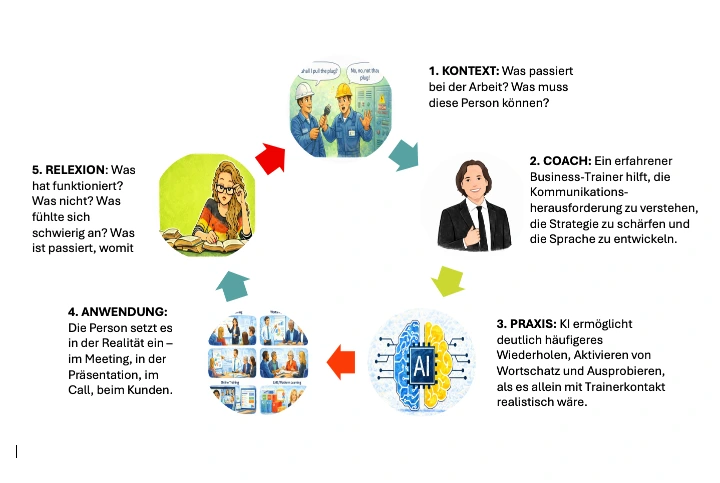
A more interesting model begins in real work life.
This is exactly what leads to the next human session. Instead of a linear course, a cycle emerges:
Real Business → Expert Coaching → AI Practice → Application in the Workplace → Reflection
„Some of the best sessions start with, ‘Something happened at work this week.’ A difficult meeting, a presentation that didn't land properly, a conversation coming up tomorrow. That's not a distraction from the curriculum. That is the curriculum.“ — Sarah Hermann-Hopwood, Head of Training, executive english
What should L&D measure?
This change also raises an uncomfortable question for corporate training: What does success actually look like? For years, language training could be relatively easily measured administratively: number of learners, number of sessions, attendance, completion rates, training hours, perhaps an entry and exit level according to the CEFR.
All these metrics have their value. But they primarily show what training has taken place. They do not automatically show what has changed.
For L&D teams that need to demonstrate impact, a more meaningful model could combine activity and outcome: How often does the person practice? How much do they actually speak? Are recurring mistakes decreasing? Is confidence changing? Is measured competence increasing? Can the person now handle certain professional tasks better? Does the learner themselves perceive a difference? Does the manager as well?
The British Council study already showed that employers were more interested in task- and competency-related performance than solely in formal certificates. AI can create an additional layer here: continuous data from learning between human sessions.
Thus, the question can shift from "How many training hours have we purchased?" to "How much meaningful learning has taken place – and what can our employees do today that they couldn't do before?"
Rethinking ROI
The cost discussion is also changing. The simplified AI narrative is: machines are cheaper than trainers. This is too simplistic. Human expertise is valuable. Therefore, it should be used where real expertise is needed.
If AI can give someone an additional twenty minutes of pronunciation training, it does not necessarily mean that a highly qualified business trainer needs to sit alongside for the entire twenty minutes.
When technology repeats vocabulary, allows for multiple practice of difficult sentences, or provides basic feedback, trainer time can be focused on the complex, context-based work where professional judgement matters.
This does not necessarily mean investing less in development. It means getting more learning impact from the same investment.
Why executive english has waited 16 years for AI
At executive english, we have been working for 16 years with professionals and executives who need English to do their jobs.
And in a way, we have been waiting for exactly that.
Not for technology that replaces the trainer.
But for technology that is good enough to relieve the trainer.
“For 16 years, we've watched highly qualified trainers spend valuable time on work that technology ought to be able to support — repetition, drilling, vocabulary activation and straightforward correction. We've been waiting for technology good enough to take some of that workload away.” — Beth Negus, Managing Director, executive english
The main reason is not cost savings.
It's about what becomes possible as a result.
When AI takes on a larger part of the repetitive work, the trainer must become smarter – not cheaper.
“AI raises the bar for the trainer. If technology can handle more of the repetitive practice, the human has to bring something more — business experience, judgement, context, nuance and an understanding of what is actually at stake.” — Beth Negus
This thought underpins the model that executive english has developed together with Loora.
Learners gain access to conversational AI for frequent individual practice, while experienced executive-english trainers provide human support, professional context, and accountability.
The goal is not simply to attach an app to an existing course.
It is about re-integrating both forms of learning.